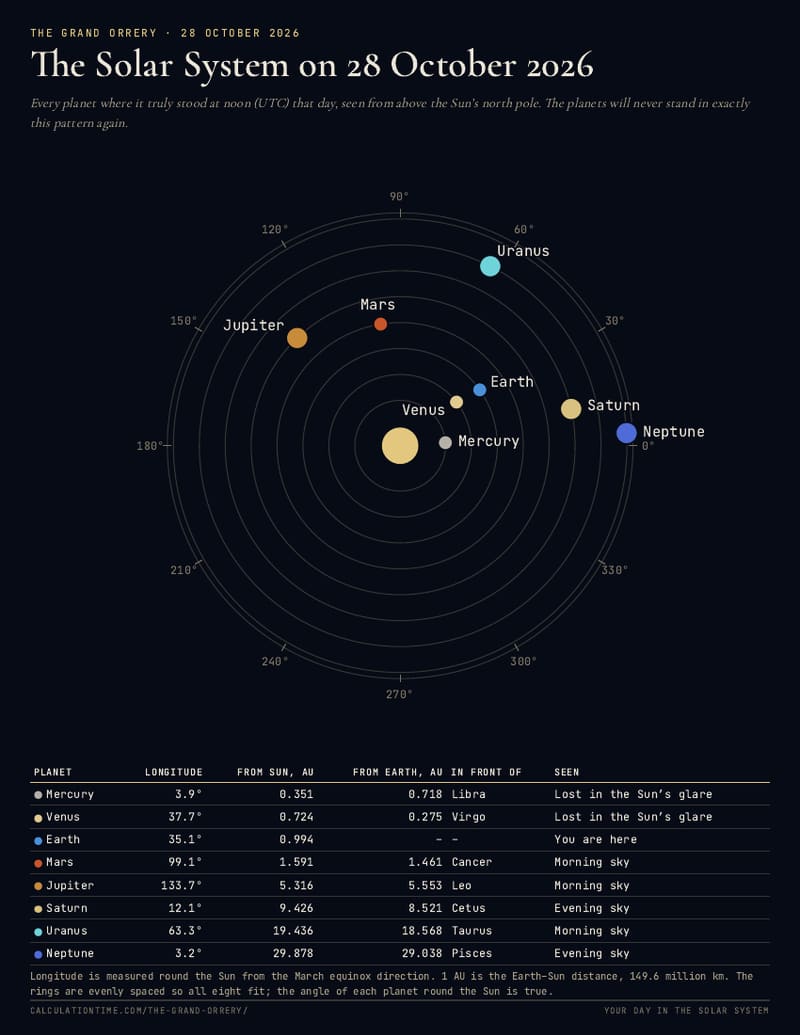
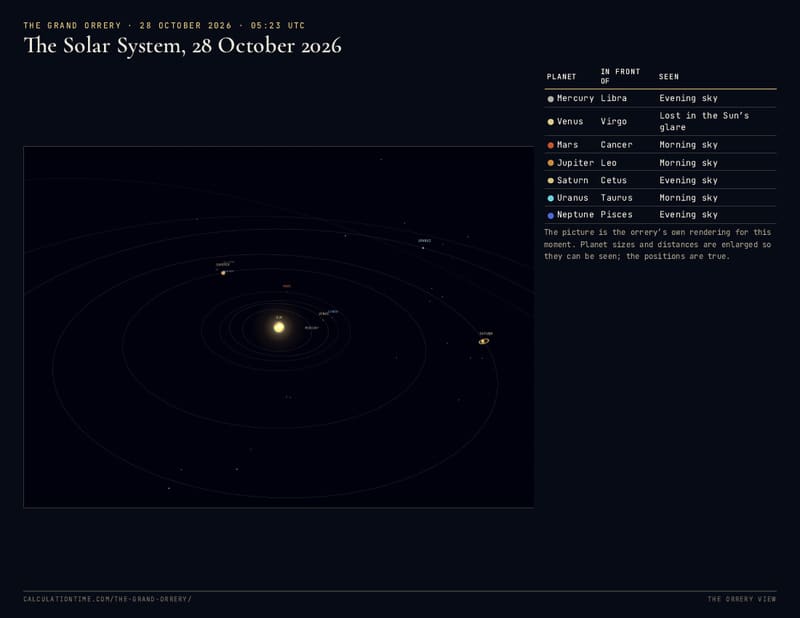
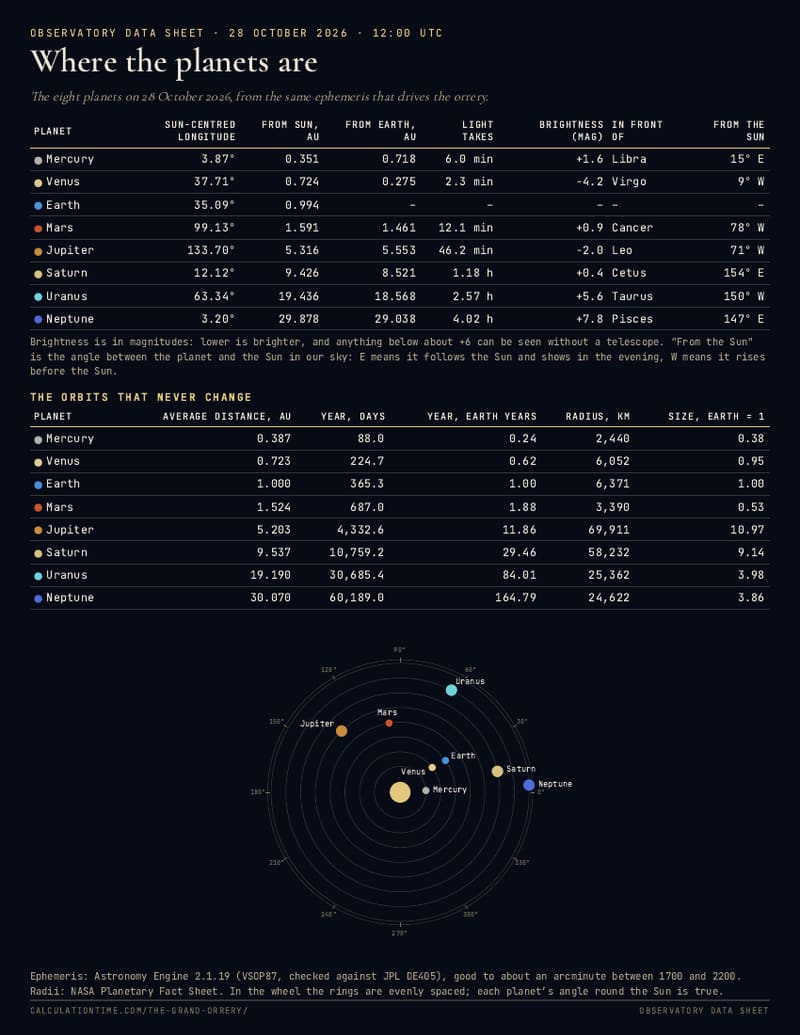
The Solar System in three dimensions, for today or any day from 1700 to 2200. Every planet stands exactly where it really was, or will be, on the date you choose.
Open full screenDrag to turn the view, scroll or pinch to zoom, and use the date bar to travel in time.
The answer
Where the planets are on 2 November 2026
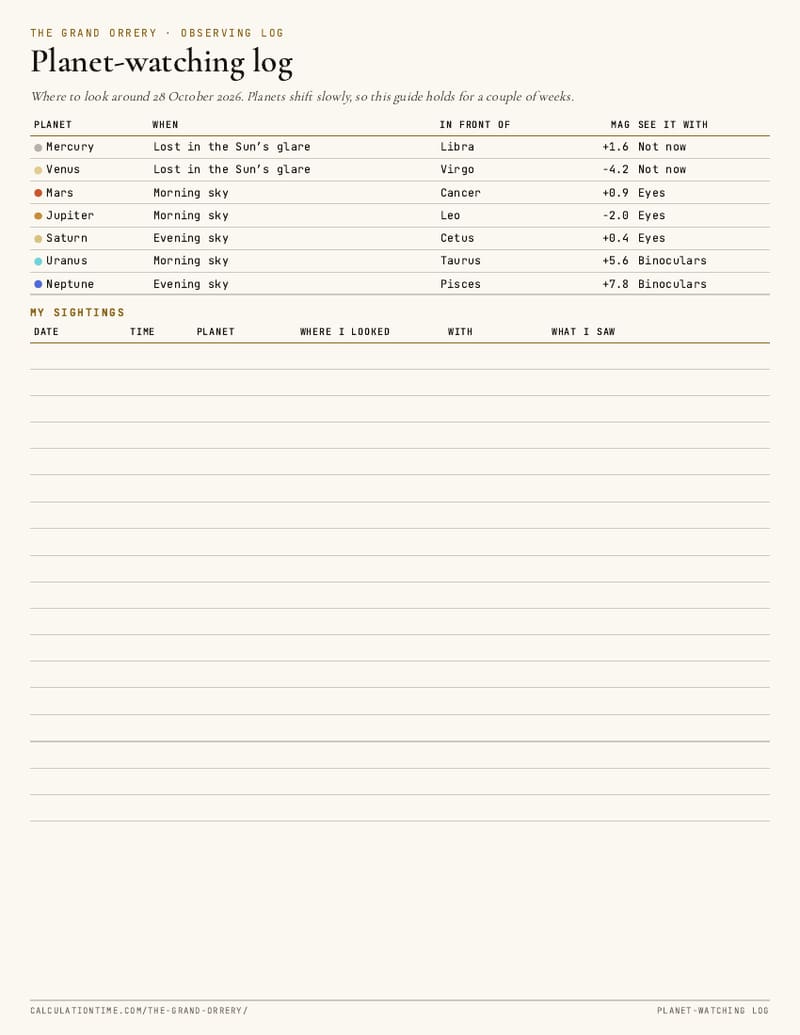
After sunset, look for Saturn. Before dawn, Venus, Mars and Jupiter are up. Mercury is too close to the Sun to see. The nearest planet to us is Venus, 0.28 AU away; its light takes 2.4 minutes to arrive.
Planet
Round the Sun
From the Sun
From Earth
Light takes
In front of
When to look
See it with
Mercury
30.1°
0.326 AU
0.674 AU
5.6 min
Libra
Lost in the Sun’s glare
Not now
Venus
45.7°
0.723 AU
0.283 AU
2.4 min
Virgo
Morning sky
Eyes
Earth
40.1°
0.992 AU
–
–
You are here
–
–
Mars
101.5°
1.596 AU
1.420 AU
11.8 min
Leo
Morning sky
Eyes
Jupiter
134.1°
5.317 AU
5.478 AU
45.6 min
Leo
Morning sky
Eyes
Saturn
12.3°
9.425 AU
8.560 AU
1.19 h
Cetus
Evening sky
Eyes
Uranus
63.4°
19.435 AU
18.529 AU
2.57 h
Taurus
Morning sky
Binoculars
Neptune
3.2°
29.878 AU
29.088 AU
4.03 h
Pisces
Evening sky
Binoculars
Positions at noon UTC. “Round the Sun” is the planet's angle from the March equinox direction, the same angle the orrery draws. Uranus needs binoculars; Neptune needs good binoculars or a small telescope.
Next time each outer planet is at its best
Mars: 19 February 2027
Jupiter: 11 February 2027
Saturn: 18 October 2027
Uranus: 25 November 2026
Neptune: 28 September 2027
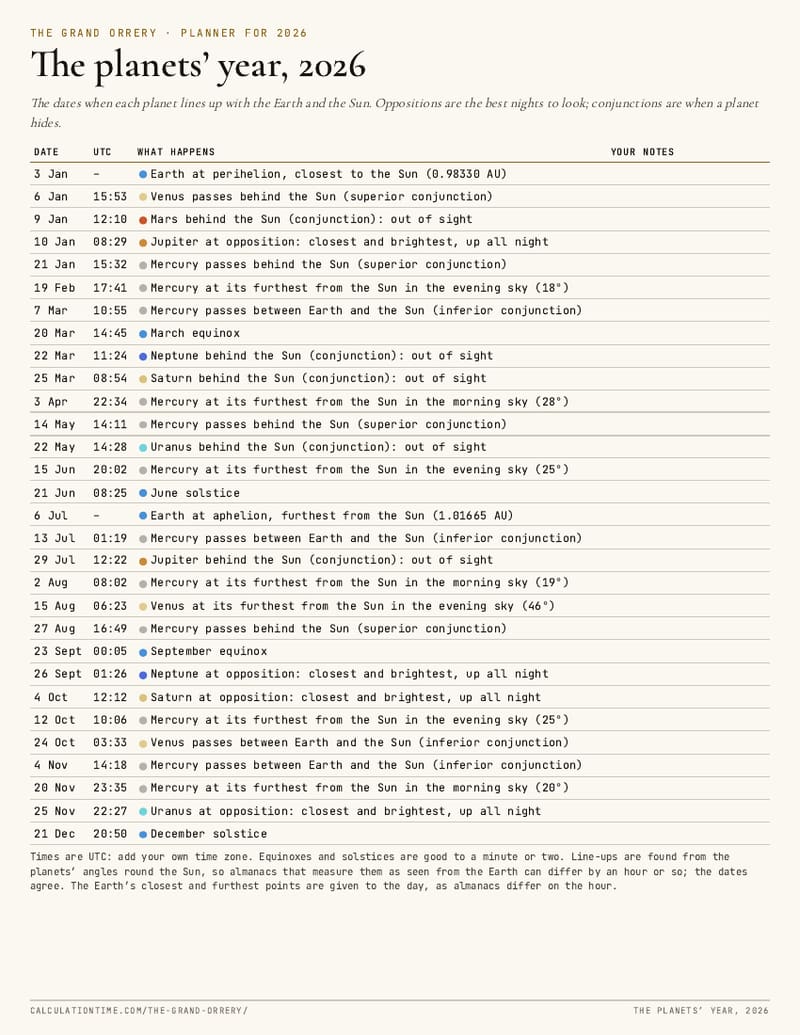
These are oppositions: the Earth passes between the Sun and the planet, so it is closest, brightest and up all night.
How to read it
A clock with eight hands
Each planet is a hand and the Sun is the spindle. Press play and the hands run at their true relative speeds: Mercury laps the Sun four times while the Earth goes round once, and Neptune has gone round only once since it was discovered in 1846.
Vantage moves your eye: tilted, straight down from above the Sun's north pole, edge on, or close in on the inner four.
Scale swaps between bodies you can see and their true sizes, and between squeezed and true distances. The badge in the corner always says which is showing.
Geometry draws the angles between the planets as seen from the Sun, and lists the line-ups within the tolerance you set.
Click a planet for its distance from the Sun and from us, how long its light takes, its brightness, its spin and its tilt on that date, then Frame this world to fly to it.
The working: Kepler's third law
A planet's year in Earth years equals its average distance from the Sun in AU raised to the power 1.5. The orrery doesn't use this shortcut (it uses the full planetary tables), but the law shows why the hands run at the speeds they do.
Planet
Average distance
Distance1.5
Measured year
Mercury
0.387 AU
0.24 years
0.24 years
Venus
0.723 AU
0.61 years
0.62 years
Earth
1.000 AU
1.00 years
1.00 years
Mars
1.524 AU
1.88 years
1.88 years
Jupiter
5.203 AU
11.87 years
11.86 years
Saturn
9.537 AU
29.45 years
29.46 years
Uranus
19.190 AU
84.06 years
84.01 years
Neptune
30.070 AU
164.89 years
164.79 years
Worked examples
Three dates, worked out
1 January 2000
At the start of the millennium the evening sky held Mars, Jupiter, Saturn, Uranus and Neptune, and Venus rose before dawn. Set the orrery's date to 2000-01-01 and the Earth sits at 100.4° round the Sun, 2 days before its closest approach of the year on 3 January 2000.
Mars comes close every 26 months
Mars was at opposition on 16 January 2025 and returns on 19 February 2027, 765 days later. The Earth laps Mars about once every 780 days, so the best nights for Mars come round a little over two years apart.
Thirty years old, everywhere
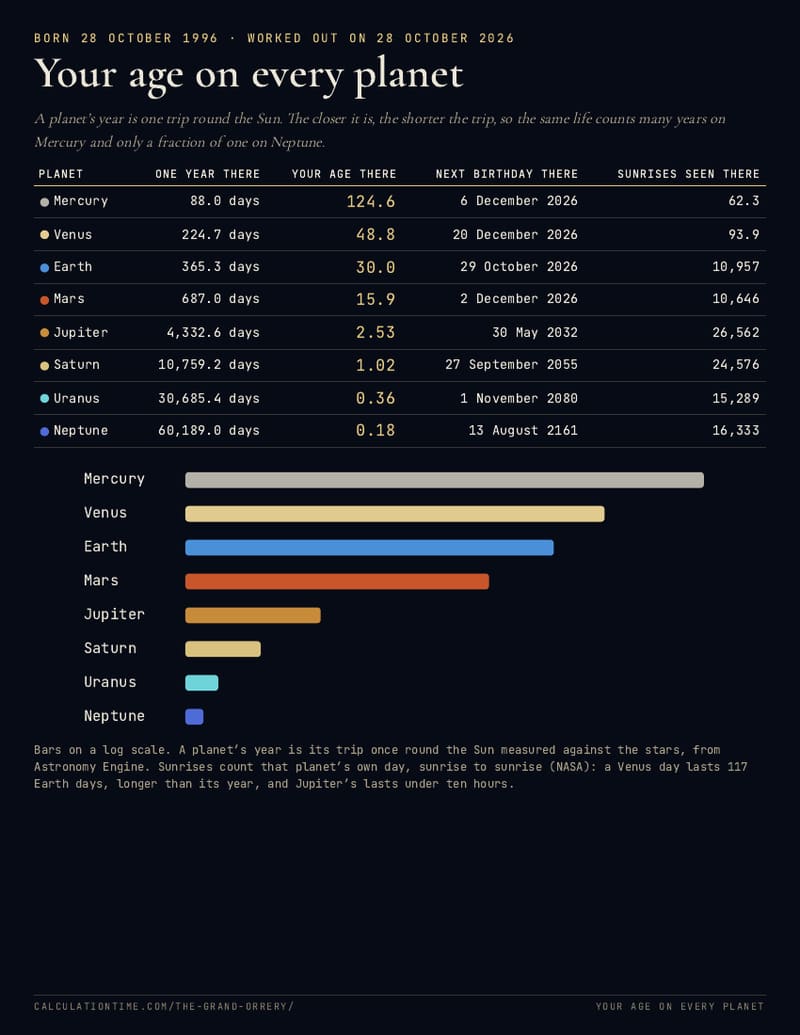
A person who has lived 30 Earth years is 124.6 on Mercury, 16.0 on Mars and 2.53 on Jupiter, and has not yet seen a single birthday on Saturn, which takes 29.5 years to go round.
Good to know
What the orrery can and can't tell you
Positions are true; sizes and spacing are not. The planets are enlarged and the outer orbits pulled in so everything fits. Switch both scales to true and the planets shrink to points.
It shows the Solar System from outside. To find a planet in your own sky, use the table above: the constellation it sits in front of and whether to look after sunset or before dawn. The Sun, Moon & Sky page gives rise times for your town.
The Moon's orbit is drawn larger than true in every view, because at true scale it would sit inside the Earth's drawn globe.
Line-ups mean nothing for your life. The geometry panel measures angles; the orrery gives them no meaning.
Between 1700 and 2200 positions are good to about an arcminute. Outside those years they are approximate.
Print Room
Ten sheets to print
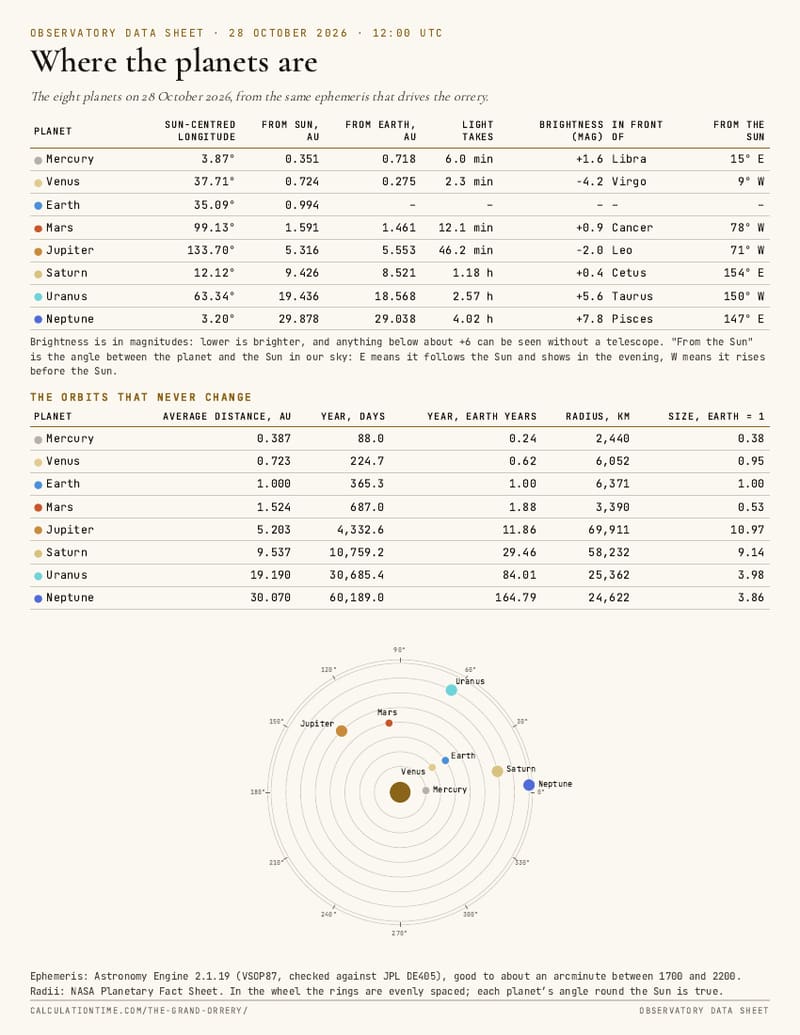
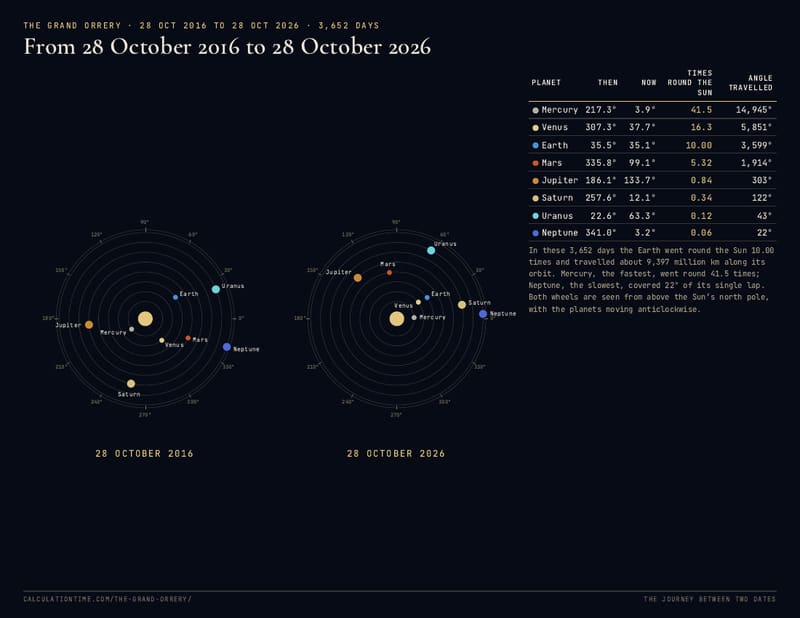
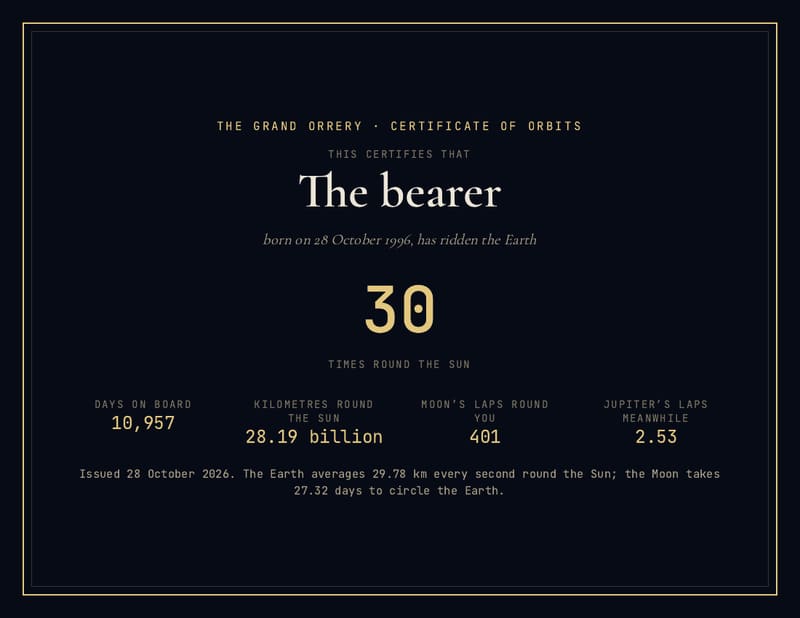
Each sheet is worked out by the orrery for your own date and prints on one page of A4 or US Letter, in Deep Space for framing or the pale Ink-Wise style for home printers. Choose one to open it in the orrery above.
Questions
Questions people ask
What is an orrery?
A working model of the Solar System, with the planets going round the Sun at their true relative speeds. The first was built in London around 1704 by George Graham and Thomas Tompion; a copy made for Charles Boyle, 4th Earl of Orrery, gave the machine its name. Brass orreries ran on gears and slowly drifted from the real sky. This one has no gears: it works out where each planet is for the moment you choose.
How accurate is the Grand Orrery?
Every position comes from Astronomy Engine, which uses the VSOP87 planetary theory checked against NASA JPL’s DE405 tables. Between 1700 and 2200 the planets are placed to about one arcminute, a thirtieth of the width of the full Moon. Outside those years it keeps working but slowly loses accuracy. It is made for learning and enjoying the sky, not for navigation or mission planning.
Why are the planets not drawn to scale?
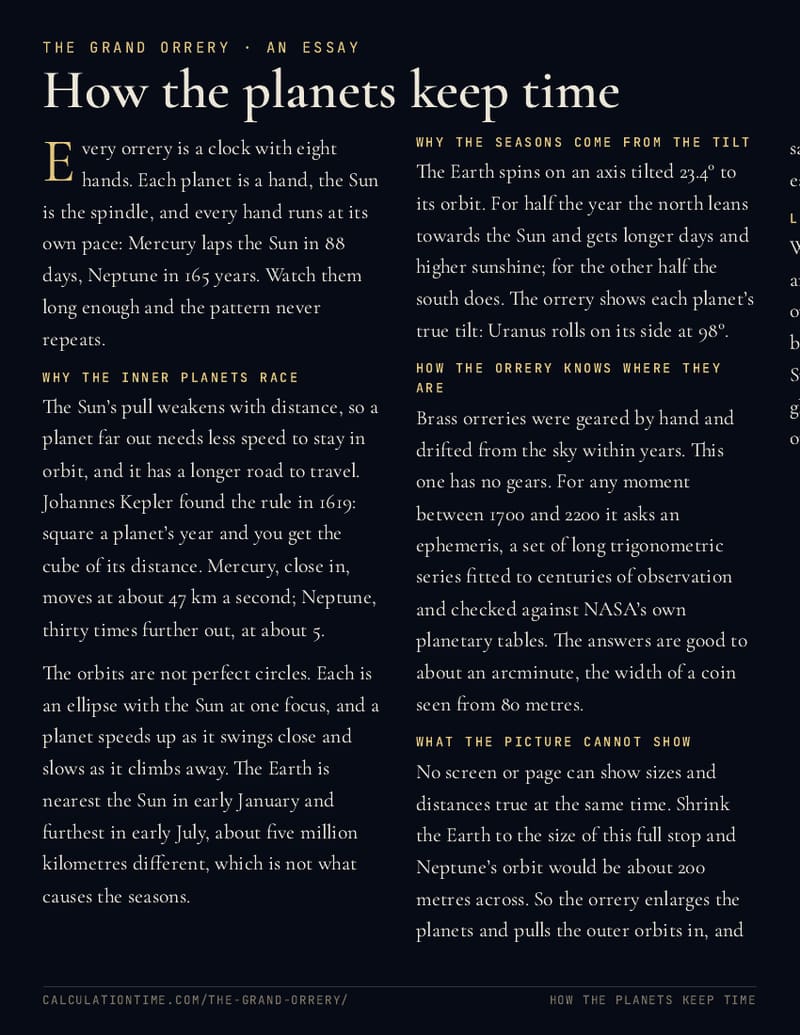
Because no screen can show true sizes and true distances at once. Neptune averages 30.07 AU from the Sun, about 4.5 billion km, while the Earth is only 12,742 km across. Shrink the Earth to a full stop and Neptune’s orbit is a couple of hundred metres wide. So the orrery enlarges the planets and pulls the outer orbits in, and the badge on screen always says which scale is showing. Where each planet sits round its orbit is always true.
Why do the inner planets move so much faster?
The Sun’s pull is stronger close in, so a planet near the Sun must move fast to stay in orbit, and it has a shorter road to travel. Mercury averages 47.4 km a second and laps the Sun in 88 days; Neptune averages 5.4 km a second and takes 165 years. Kepler’s third law ties the two together: a planet’s year in Earth years is its distance in AU to the power of 1.5. For Mars that gives 1.88 years, against a measured 1.88.
How long does light take to reach each planet?
Sunlight reaches the Earth in about 8.3 minutes, Jupiter in about 43 minutes and Neptune in about 4.2 hours, on average. The table on this page gives the light time from the Earth to each planet for the date you choose, which changes as the two move round their orbits.
What can I print from the Grand Orrery?
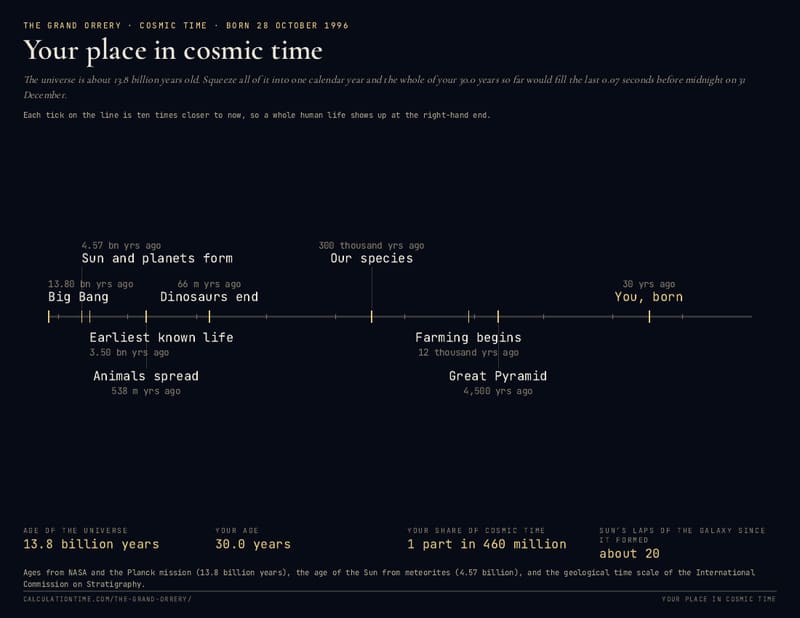
Ten sheets, each worked out for your own date: the Solar System on your day, a framed picture of the view you set up, an observatory data sheet, your age on every planet, a planner of the year’s planet line-ups, the journey between two dates, a certificate of orbits, a planet-watching log, an essay on how the planets keep time, and your place in cosmic time. Each prints on one page of A4 or US Letter, in a dark or an ink-saving pale style.