One day
In 24 hours the Sun carries us 19.87 million km round the galaxy, about 52 times the distance to the Moon, while the Earth moves 2.57 million km round the Sun.
The Observatory
The Sun is not standing still. It carries every planet round the Milky Way at about 230 km a second, so each orbit is drawn out into a coil, and no planet ever returns to where its year began.
The answer
Between 2 November 1996 and 2 November 2026, the Sun carried you 217.74 billion km round the Milky Way: 1,455 AU, about 48 times as far as Neptune is from the Sun. Light would need 201.7 hours to cover it, yet it is only 130.4 billionths of one lap of the galaxy.
The working: 10,957 days × 86,400 seconds × 230 km per second = 217.74 billion km. The Earth’s own trips round the Sun add 28.19 billion km at 29.78 km per second; the two motions point different ways, so they are not simply added.
How to read it
Draw a circle while sliding your pencil along a ruler and you get a coil. That is all the orrery shows: the planets circle the Sun while the Sun slides through the galaxy.
In one year the Sun moves 48.5 AU along its path, while the Earth's orbit is 2 AU across. So each turn of the Earth's coil runs about 24 times further forward than it is wide. Drawn true, it is a gently wavy line, not a tight spring; the orrery squeezes it so the coil can be seen.
Worked examples
In 24 hours the Sun carries us 19.87 million km round the galaxy, about 52 times the distance to the Moon, while the Earth moves 2.57 million km round the Sun.
From 20 July 1969 to 20 July 2019 the Sun carried the footprints left on the Moon, and everyone on Earth, 363 billion km: 2,426 AU, or 336.3 light-hours.
In about 4.57 billion years at one lap per 230 million years, the Sun has been round the galaxy about 20 times. A lifetime of 80 years is 0.45 arcseconds of one lap.
Good to know
Print Room
Keepsakes for a birth, a wedding or an anniversary, teaching sheets for a classroom, and art prints for the wall. Each prints on one page of A4 or US Letter, in Deep Space or the ink-saving Ink-Wise style. Choose one to open it in the orrery above.
Questions
Yes, seen from the galaxy. The Sun is not parked: it carries the planets round the centre of the Milky Way, so each planet’s loop round the Sun is stretched forward into a coil, a helix, and no planet ever comes back to the point in space where its year began. Seen from the Sun, the same orbits are closed ellipses. Both descriptions are right; they are the same motion measured from two places.
About 230 km every second round the centre of the Milky Way: 828,000 km an hour, or about 514,000 miles an hour. In a year that is about 48.5 times the distance from the Earth to the Sun. Recent measurements put the speed nearer 236 km/s; 230 is the usual round figure and the one the orrery uses. Meanwhile the Earth goes round the Sun at 29.78 km a second.
It got one thing right and two wrong. Right: the Solar System travels. Wrong: the word vortex, because nothing spirals inward and the planets keep steady distances from the Sun; and the angle, because the video drew the planets’ plane at right angles to the Sun’s path with the planets trailing behind. The real plane is tilted about 60 degrees to the galaxy’s, so every planet spends part of each orbit ahead of the Sun. Switch the orrery between True · 60° and “Vortex” myth to compare them.
Multiply your age in seconds by 230 km. Thirty years comes to about 218 billion km, 1,456 times the Earth–Sun distance, and still only 0.13 millionths of one lap of the galaxy. Over the same thirty years the Earth also travelled about 28.2 billion km round the Sun. The box on this page works it out for your own birthday.
One lap of the Milky Way takes the Sun somewhere between 225 and 250 million years; 230 million is a common middle figure. The Sun formed about 4.57 billion years ago, so it has been round about 20 times. One galactic year ago the first dinosaurs were appearing.
Round the galaxy, towards the constellation Cygnus, the Swan. The bright star Deneb lies about 6 degrees from that direction, with Vega and Altair close by: together they make the Summer Triangle. Northern skies show it on summer evenings, southern skies low in the north on winter evenings. Against the nearby stars the Sun also drifts at about 20 km a second towards Hercules, near Vega.
Sources
Related
Printables
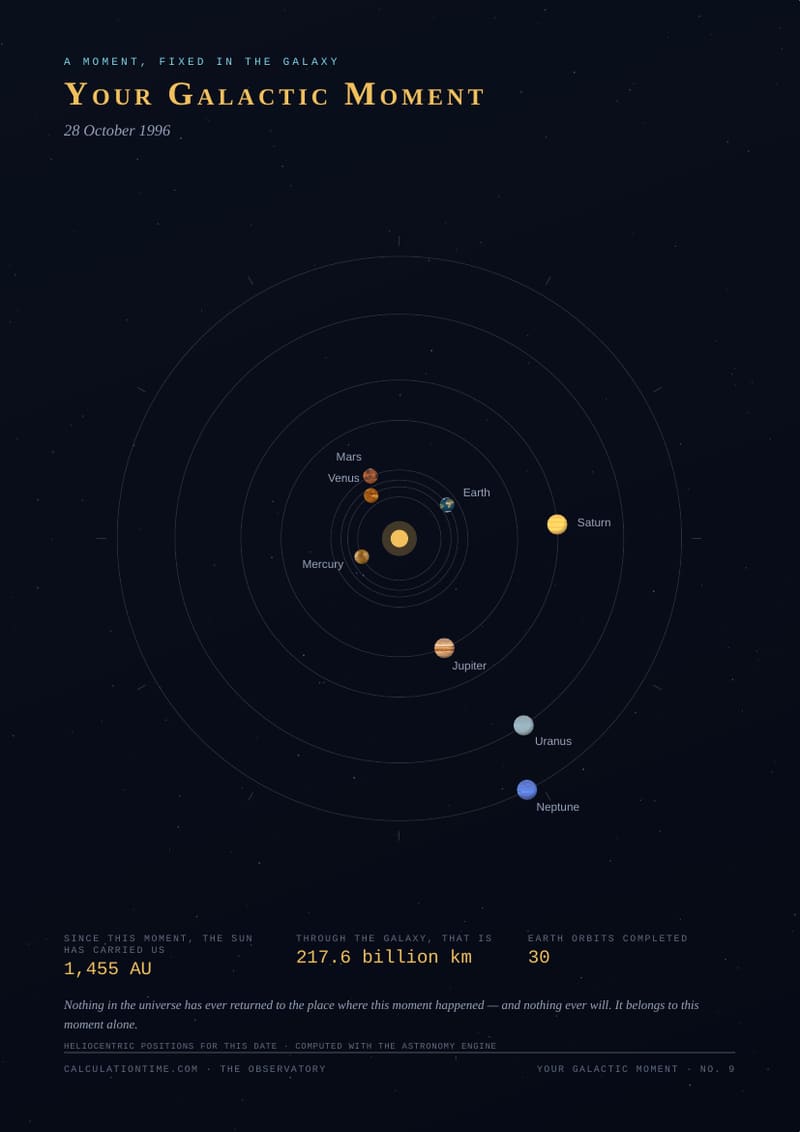 Your Galactic Moment: the planets on your day, and the distance sincePrint thisPin it
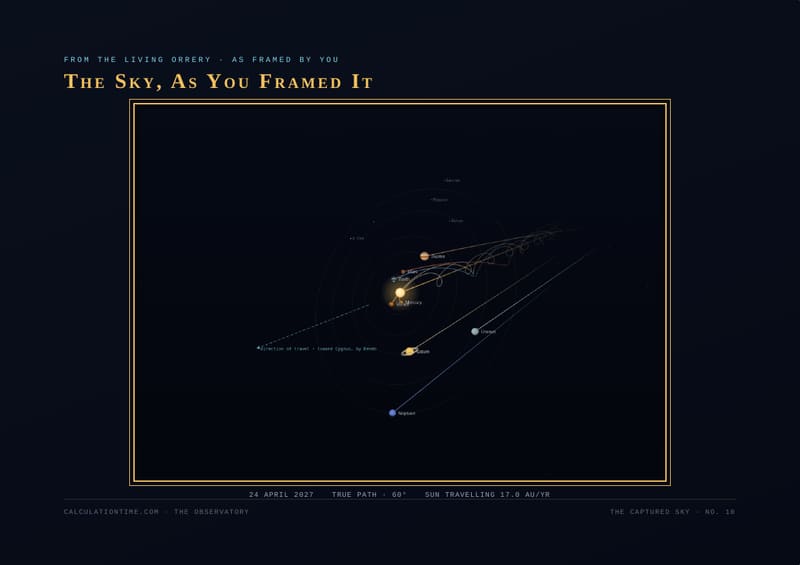 The Captured Sky: the coil as you framed itPrint thisPin it
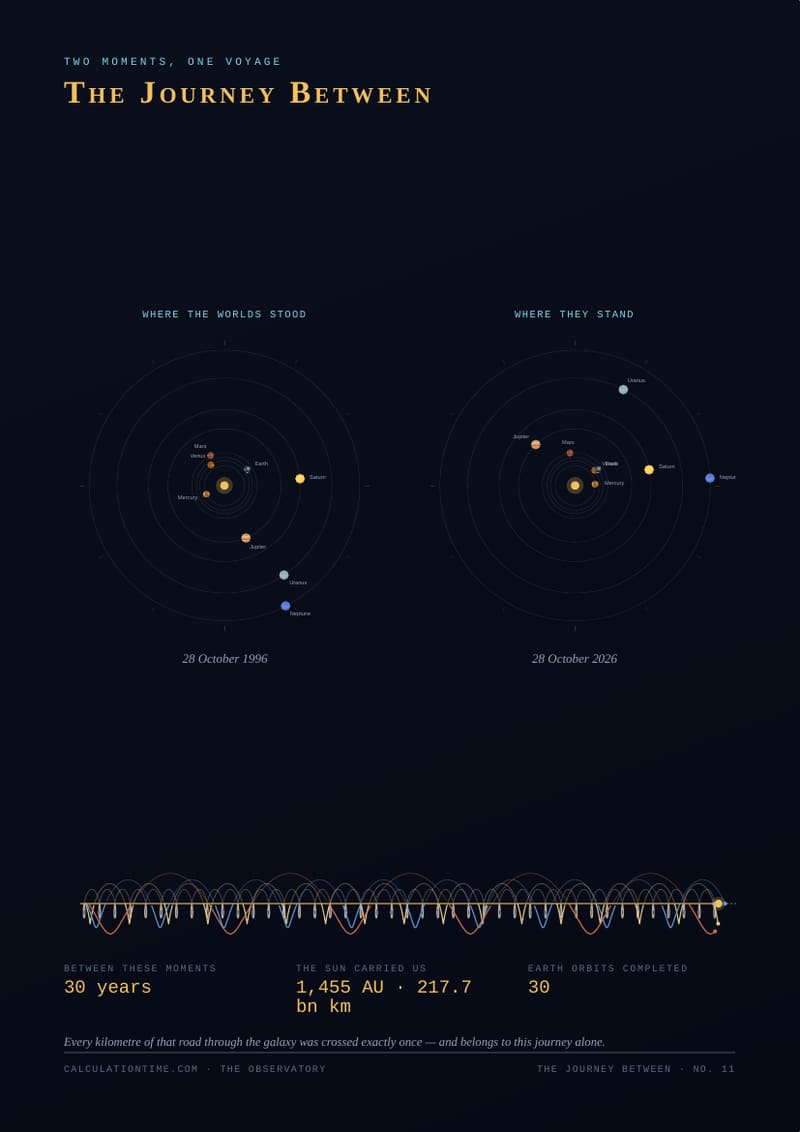 The Journey Between: two dates and the galaxy crossed between themPrint thisPin it
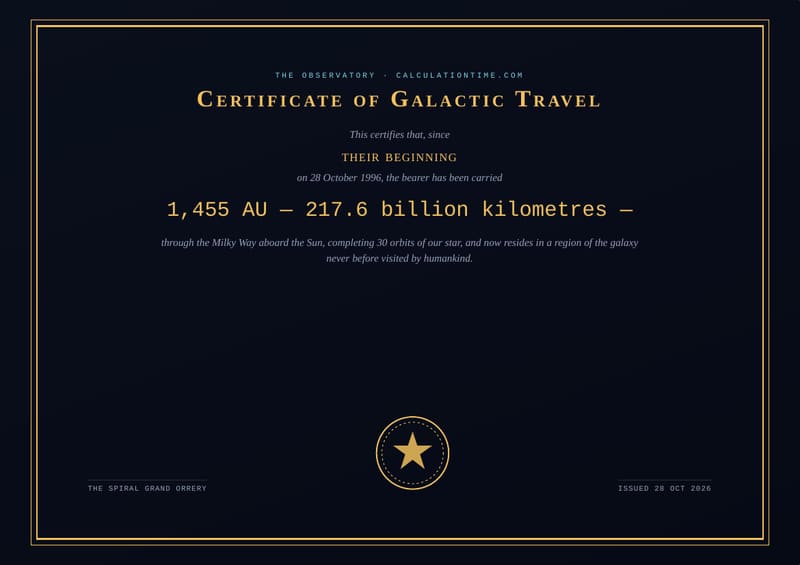 The Traveller’s Certificate of galactic travelPrint thisPin it
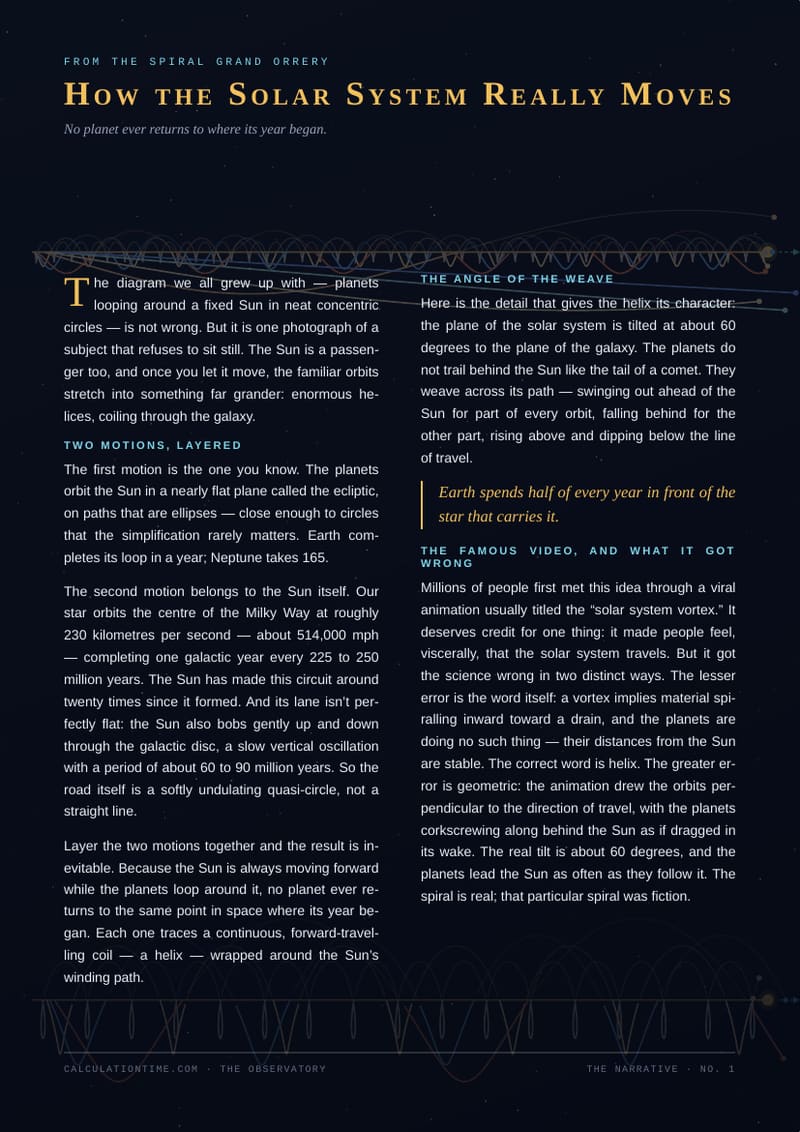 How the Solar System Really Moves: the essay for the wallPrint thisPin it
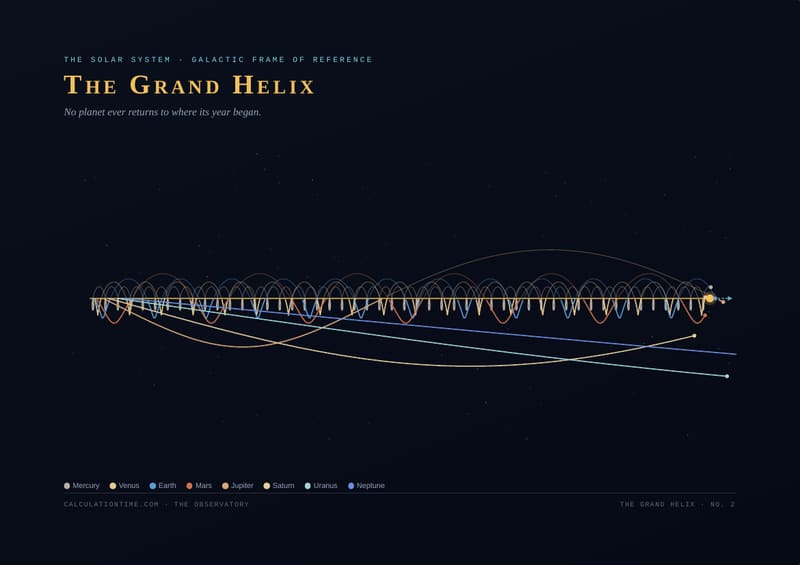 The Grand Helix: all eight worlds coiling round the moving SunPrint thisPin it
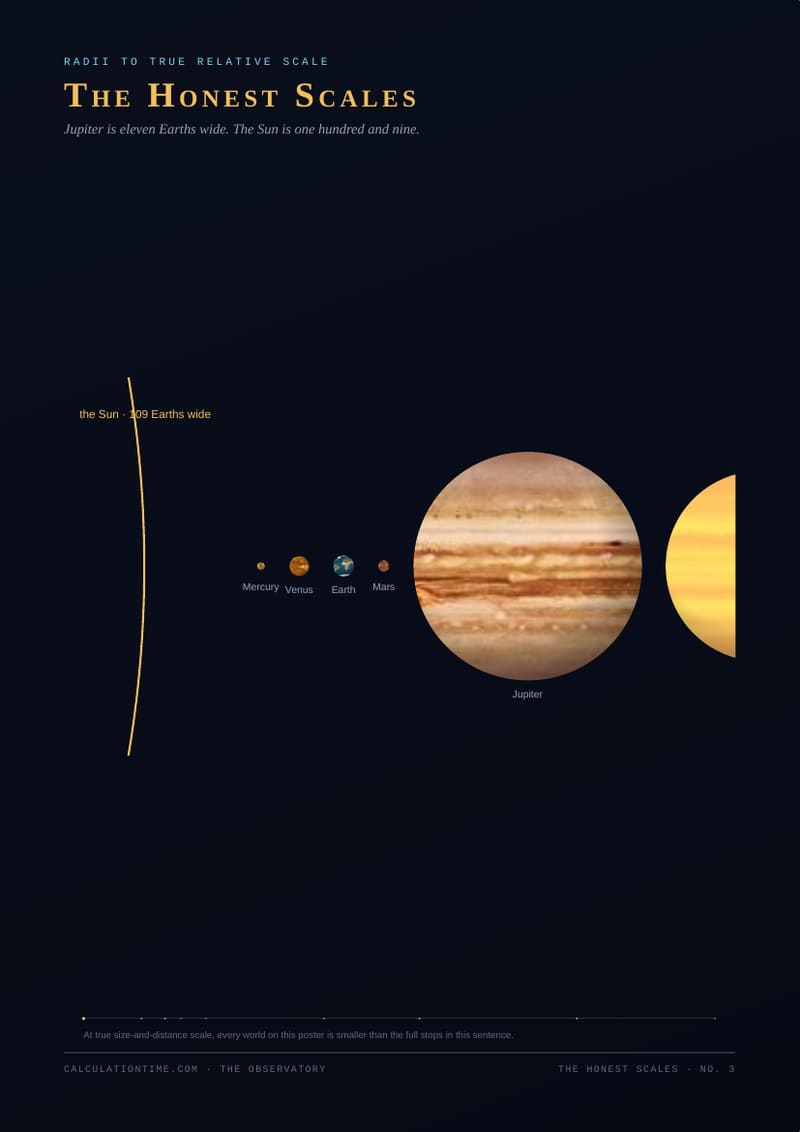 The Honest Scales: the planets at true relative sizePrint thisPin it
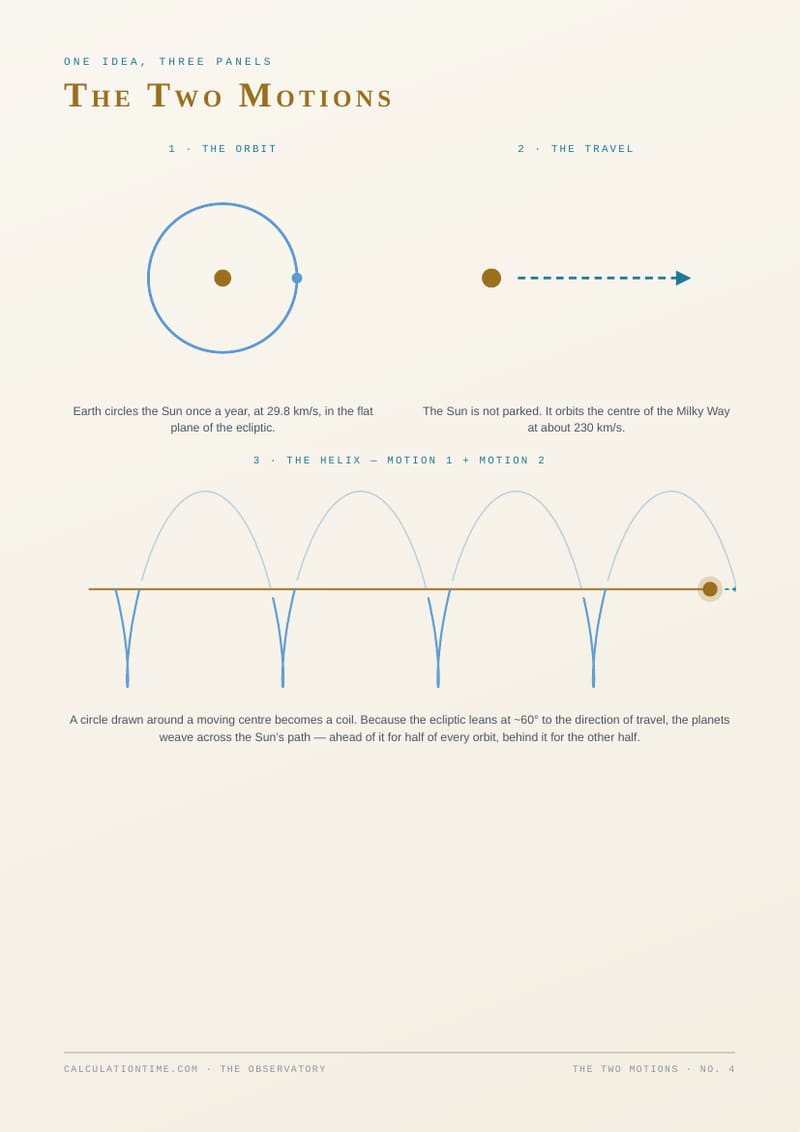 The Two Motions: a teaching sheet in three panelsPrint thisPin it
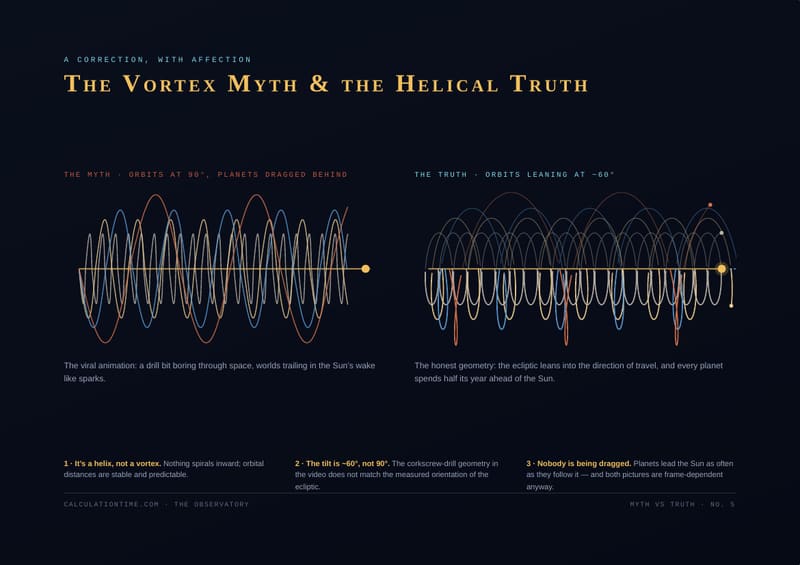 Myth vs Truth: the vortex video beside the real helixPrint thisPin it
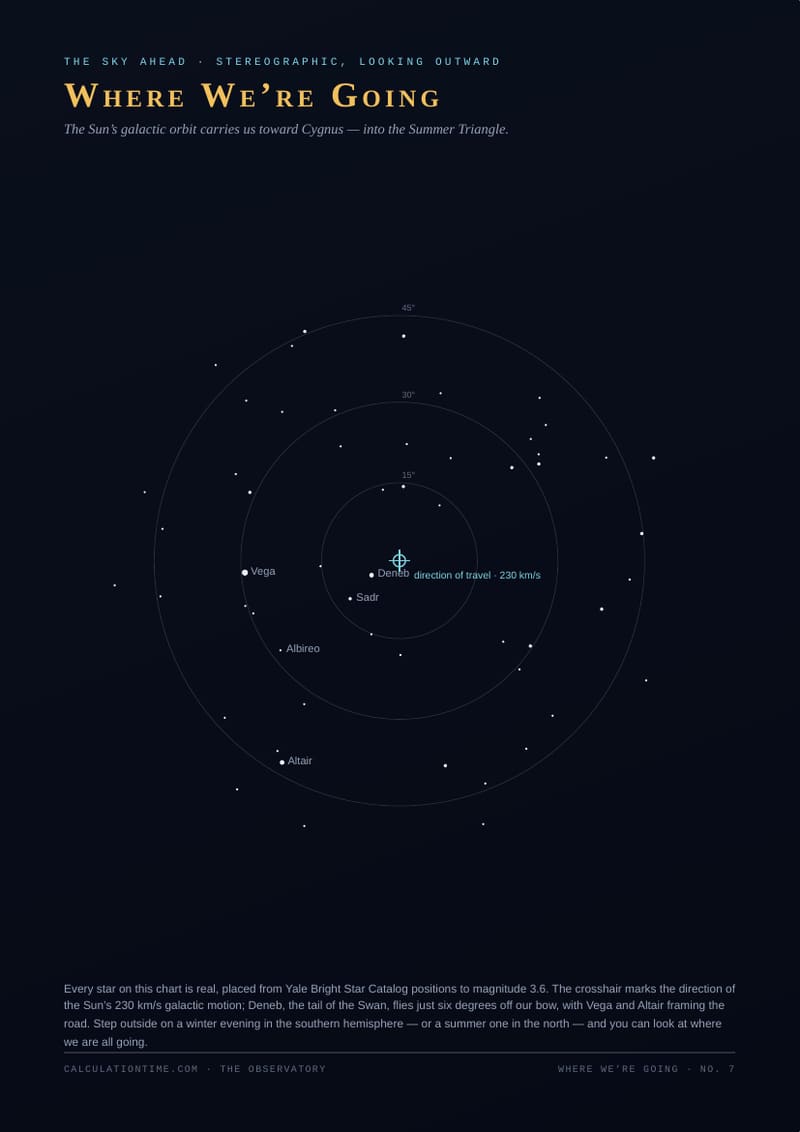 Where We’re Going: a star chart of the sky aheadPrint thisPin it
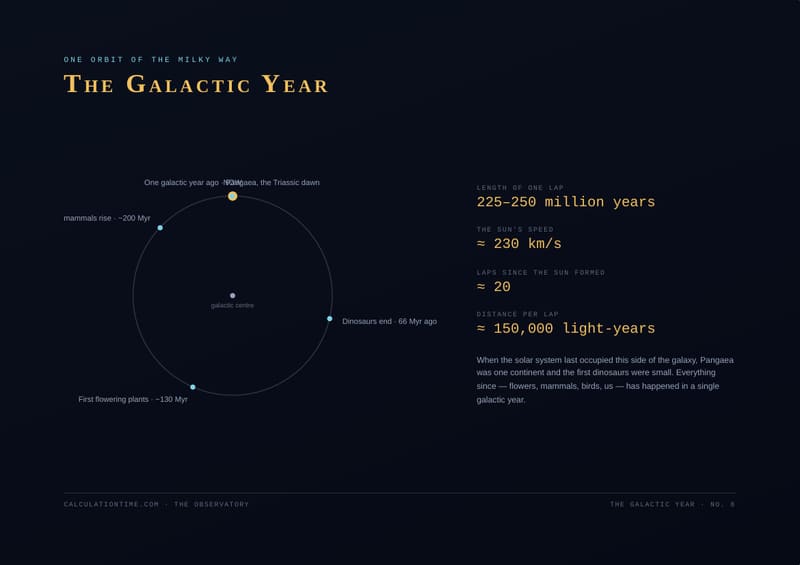 The Galactic Year: one lap of the Milky WayPrint thisPin it
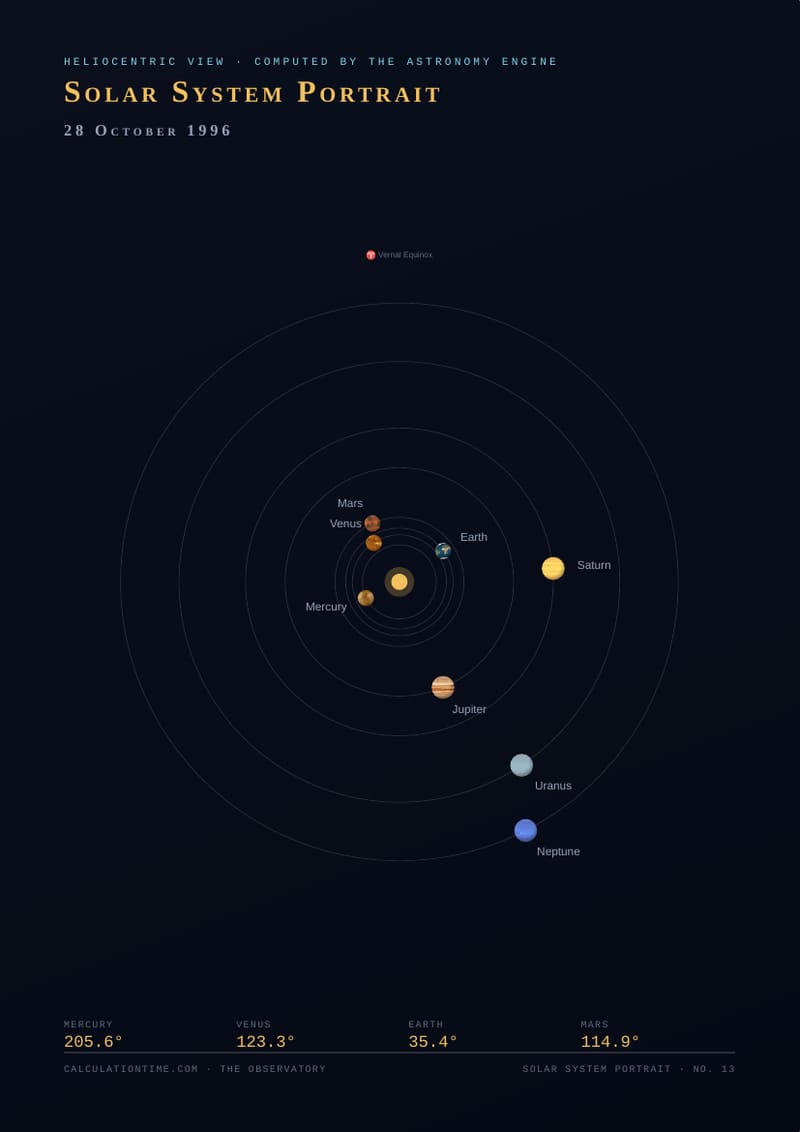 Solar System Portrait: the eight worlds on any datePrint thisPin it
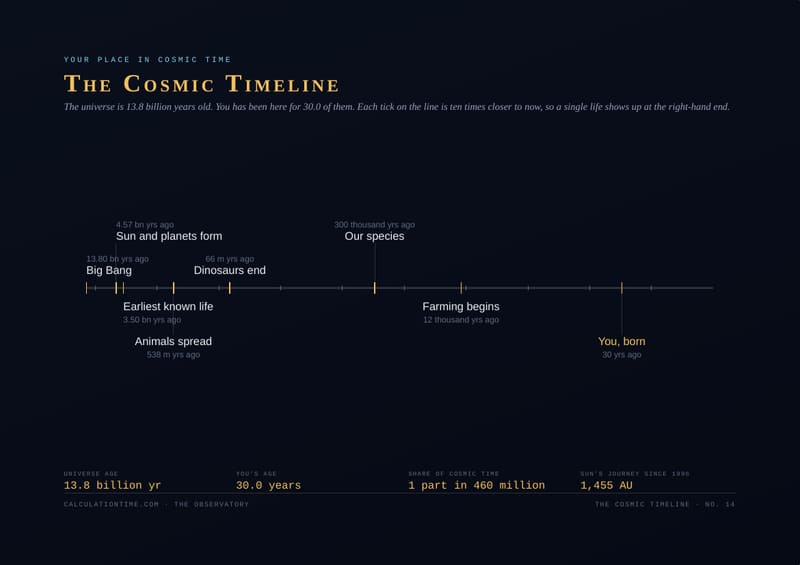 The Cosmic Timeline: a life against 13.8 billion yearsPrint thisPin it
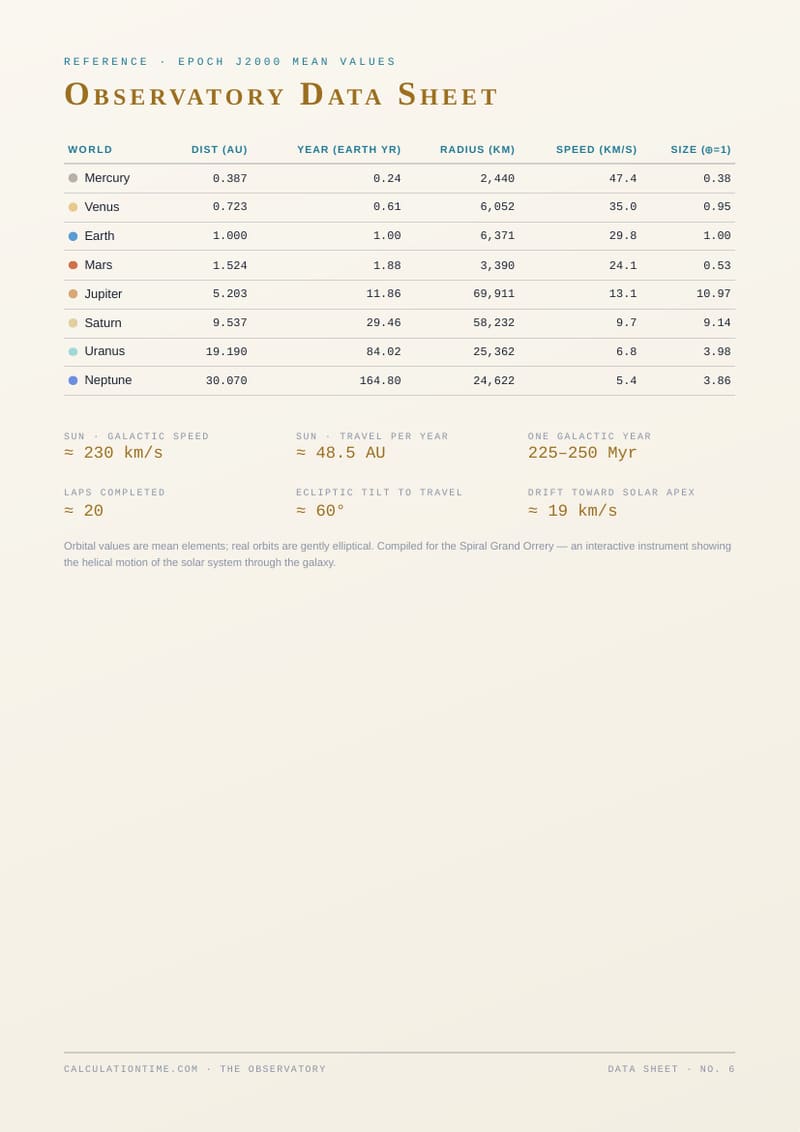 Observatory Data Sheet: the planets’ working numbersPrint thisPin it